ActivePusher
Active Learning and Planning with Residual Physics for Nonprehensile Manipulation
Worcester Polytechnic Institute · ELPIS Lab
Accepted to ICRA 2026
Active learning
Collecting informative interactions improves pushing dynamics model efficiently.
Active planning
Uncertainty-aware planning favors reliable actions during task execution.
Learn where uncertain. Plan where reliable.
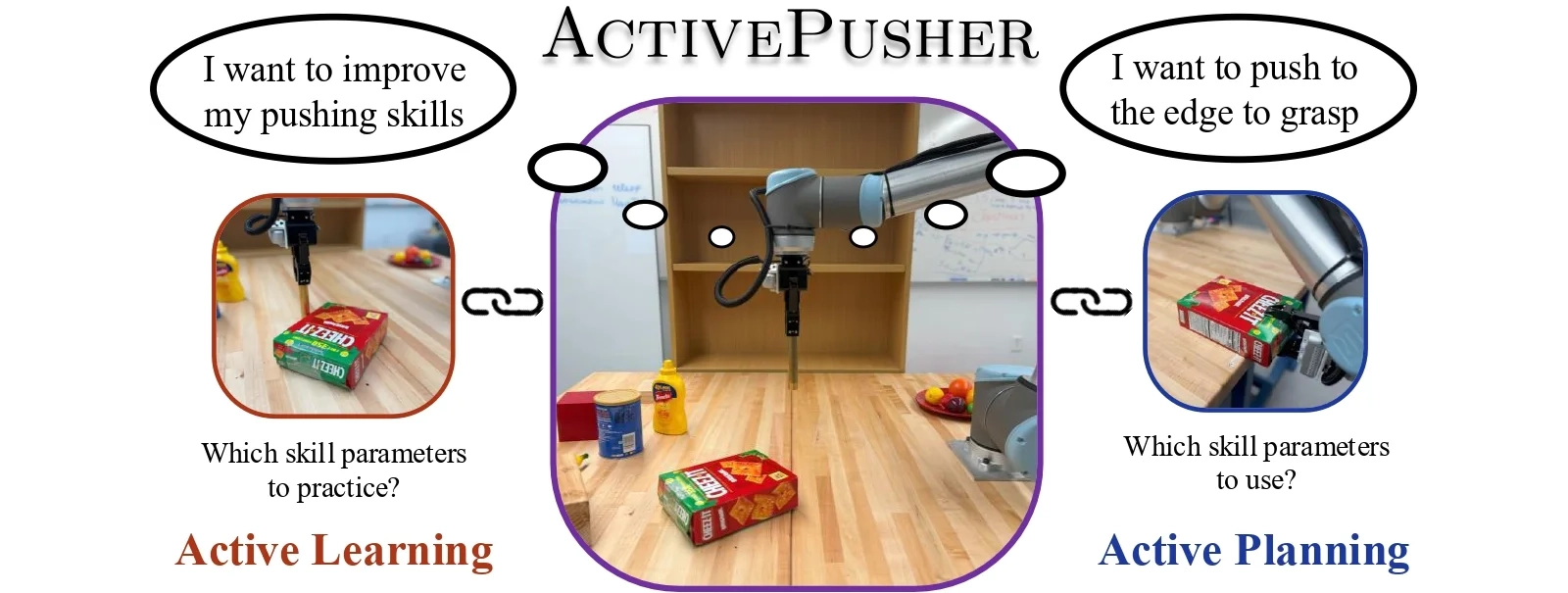
Planning with learned dynamics can unlock versatile nonprehensile manipulation, but collecting robot data is expensive and prediction errors can compound over long horizons. ActivePusher joins residual physics, uncertainty-aware active learning, and kinodynamic planning in one framework: the robot practices the pushes that teach it the most, then favors high-confidence actions when it is time to act.
The result: more data-efficient model learning and higher planning success in both simulation and real-world pushing tasks—without high-fidelity simulation, large offline datasets, or human demonstrations.
One uncertainty signal, two roles
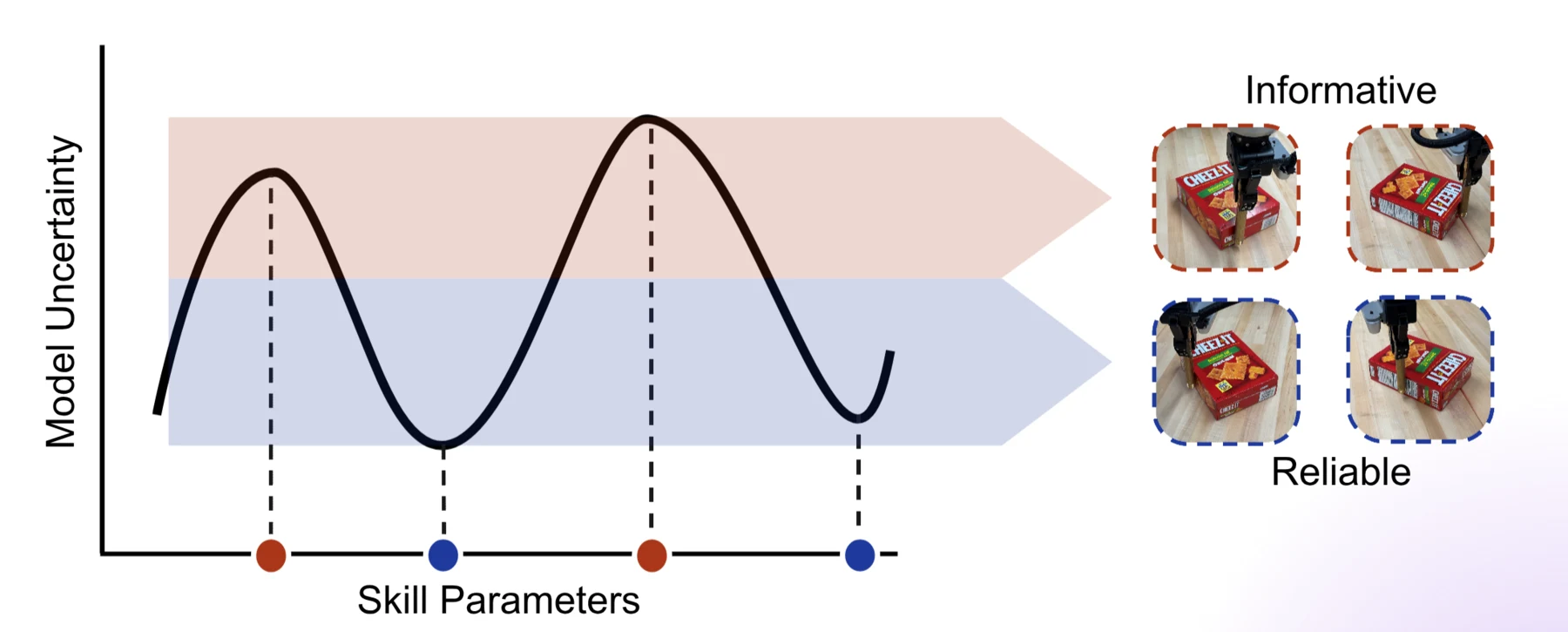
Active learning
ActivePusher estimates epistemic uncertainty with the neural tangent kernel and uses BAIT to select a batch of skill parameters with high expected information gain. Each real interaction is chosen to improve the dynamics model efficiently.
Active planning
The same uncertainty estimate biases the kinodynamic planner toward controls in well-explored parts of the skill space. Plans are built from actions the learned model can predict with greater confidence.
Push to region
Push-to-region trial 1
Push-to-region trial 2
Push-to-region trial 3
Push-to-region trial 4
The robot plans and executes multi-step pushes that move a mustard bottle into a target region while accounting for model uncertainty.
Push to edge for grasping
Push-to-edge trial 1
Push-to-edge trial 2
Push-to-edge trial 3
Push-to-edge trial 4
With obstacles on the table, the planner moves a cracker box to a reachable edge so the robot can complete the task with a grasp.
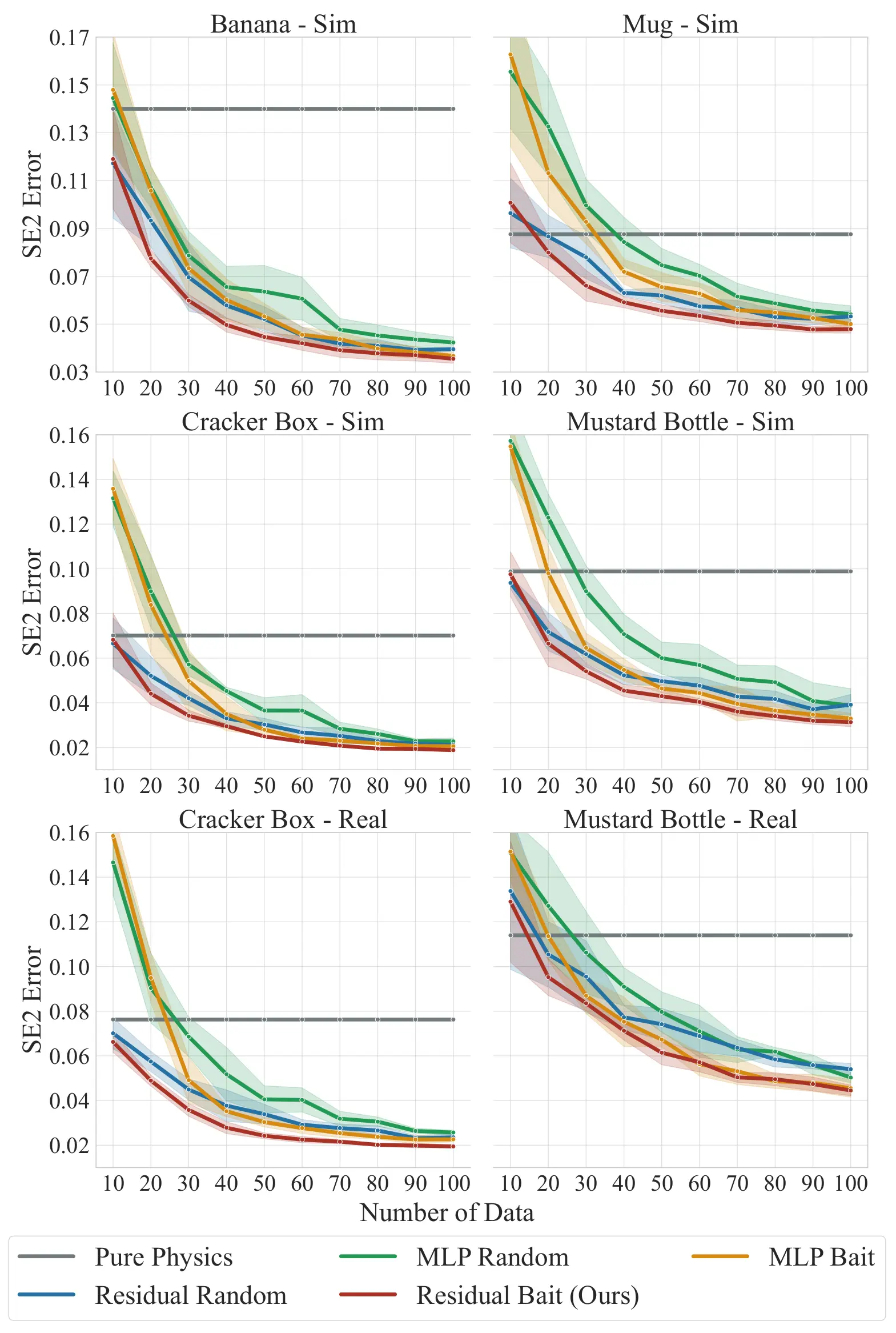
Residual physics for low-data learning
A coarse analytical pushing model supplies a useful physical prior. A neural network learns only the residual correction between that approximation and observed object motion, retaining physical structure while adapting to object- and contact-specific behavior.
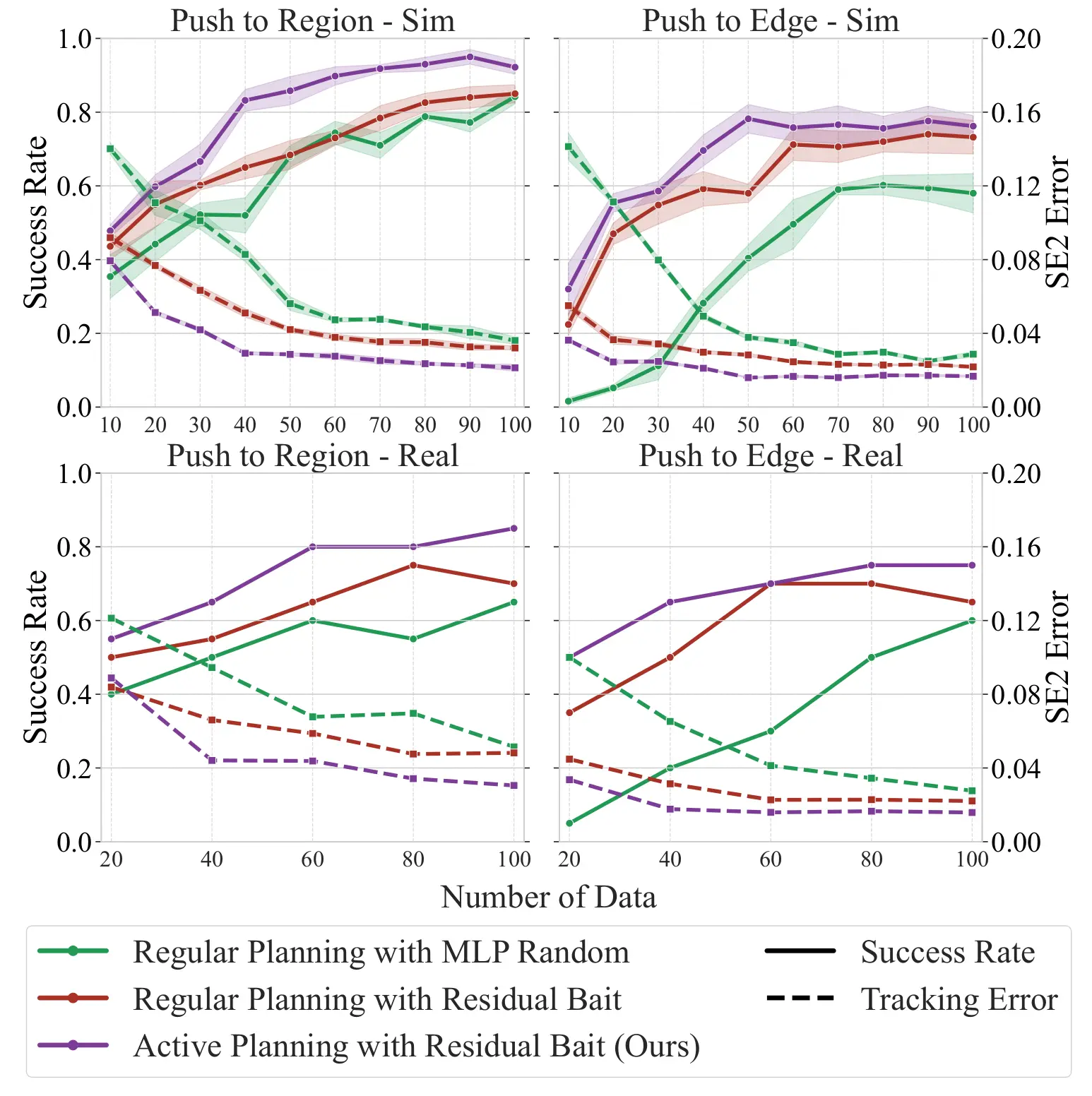
Uncertainty-aware planning improves execution
Active sampling steers the planner toward actions with lower model uncertainty. Across planning conditions, this produces more executable plans, improves success, and reduces the gap between planned and observed object motion.
Acknowledgments
This work was supported in part by NSF CRII Grant No. 2451108, an Amazon WPI Robotics Engineering gift, and Worcester Polytechnic Institute funds.