AURA
Asymptotically Optimal Uncertainty-Robust Replanning Algorithm for Kinodynamic Systems
Worcester Polytechnic Institute · ELPIS Lab
Accepted to IEEE Robotics and Automation Letters (RA-L), 2026
Global Replanning Module
The planner keeps searching the state space during execution and switches to lower-cost trajectories as it finds them.
Local Optimization Module
Optimized controls are precomputed for possible execution outcomes, recoverying the system back toward the nominal trajectory.
Keep the Planner Alive During Execution!
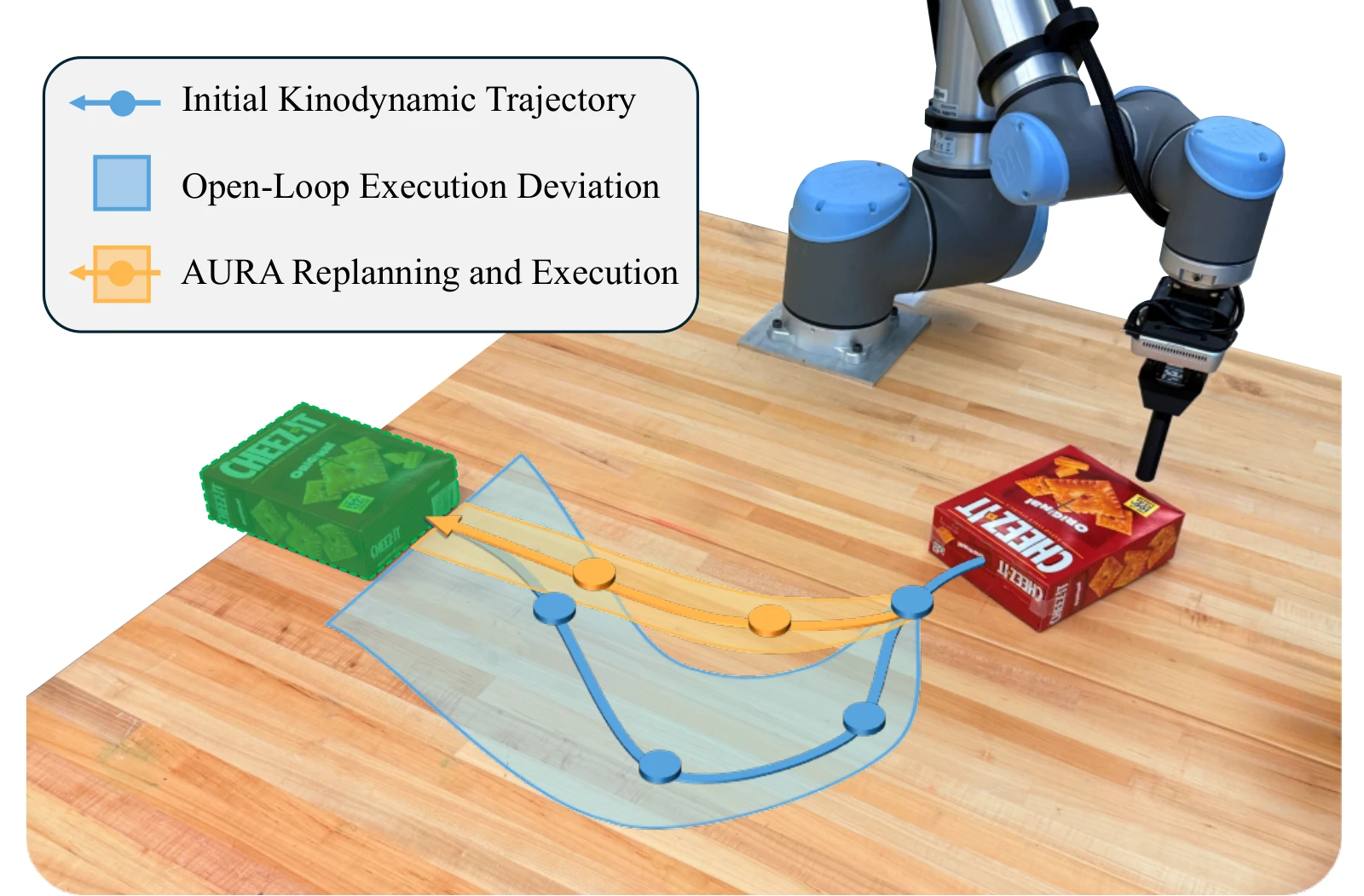
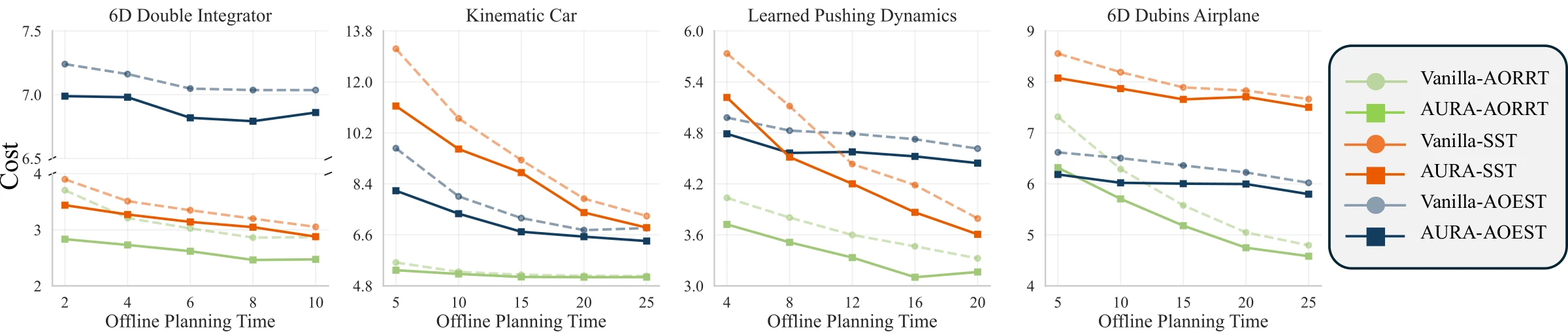
Sampling-based kinodynamic planners handle systems with complex dynamics, but they are usually run offline: the robot waits for a plan, then executes it blindly. Under a limited time budget the plan is often suboptimal, and under model mismatch the system deviates. AURA wraps around any asymptotically optimal planner and puts each execution interval to work, improving the trajectory quality and precomputing corrections beforehand.
The result: Lower-cost trajectories with any initial planning budget, up to 72% less execution deviation than open-loop execution, and up to 50% shorter total task time than receding-horizon and replanning baselines, all without a steering function.
3 Threads, 1 Parallel cycle
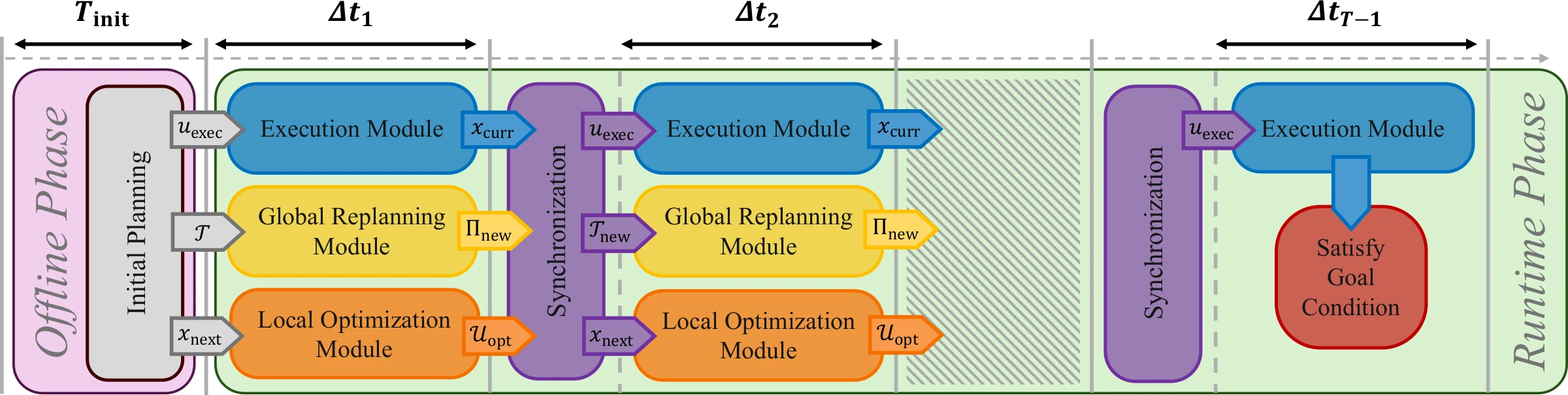
AURA is a meta-planner on top of an asymptotically optimal sampling-based planner, such as AO-RRT, AO-EST, or SST. While the system executes the first control, two other modules use the same time window. One searches for a better global plan, the other prepares local recovery controls. At the end of each cycle, AURA evaluates candidate plans from the observed state, chooses the best one, and picks the next control to execute.
Global Replanning Module
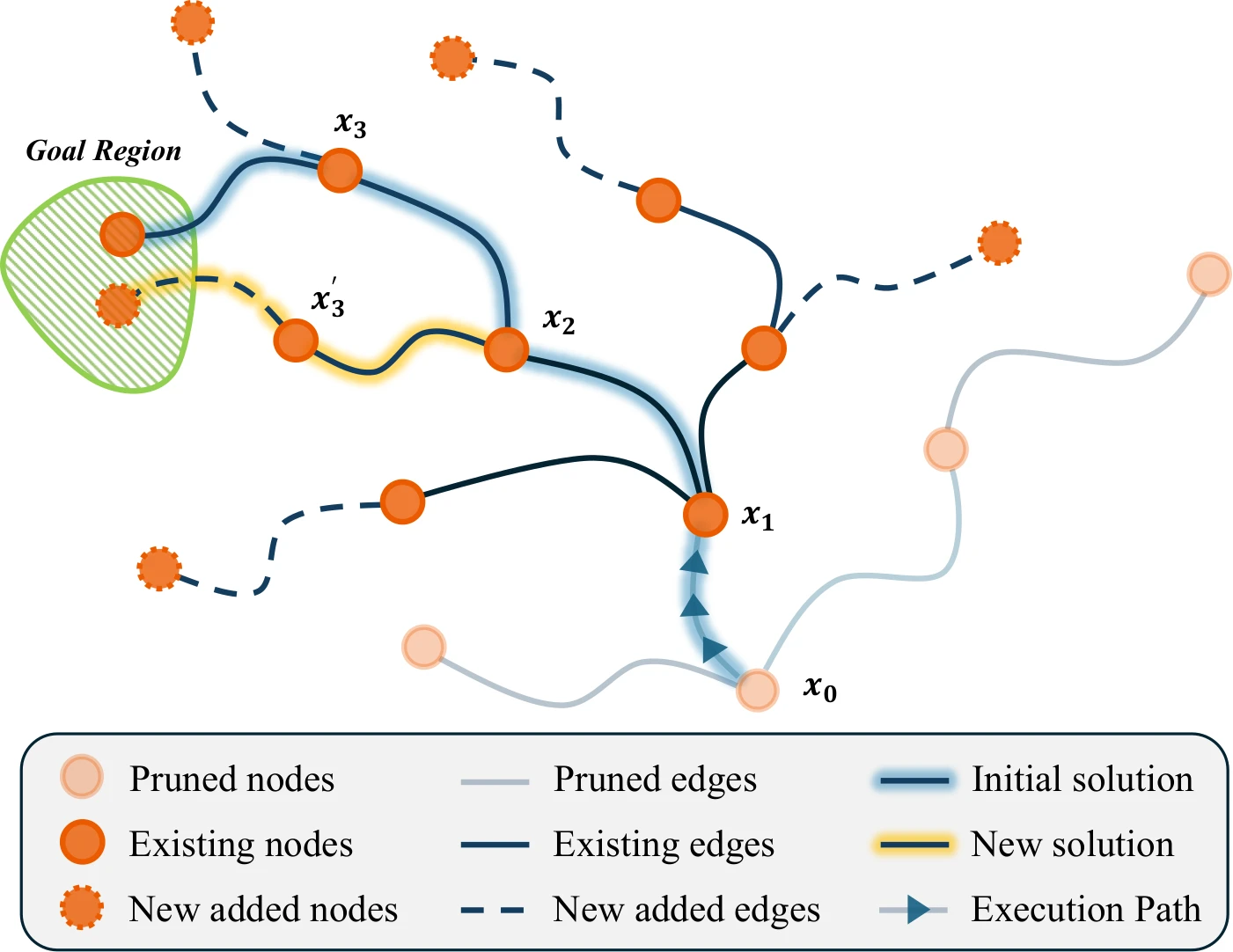
Pruning stage
Once the first control is committed, the next planned state becomes the new root. Only branches that cannot be reached without a steering function are removed; the rest of the exploration progress is kept.
Replanning stage
As the underlying planner is asymptotically optimal, every extra nodes of search during execution has a chance to find a cheaper path, so the system can start the execution once a feasible plan is found and the rest of the planning can happen online.
Local Optimization Module
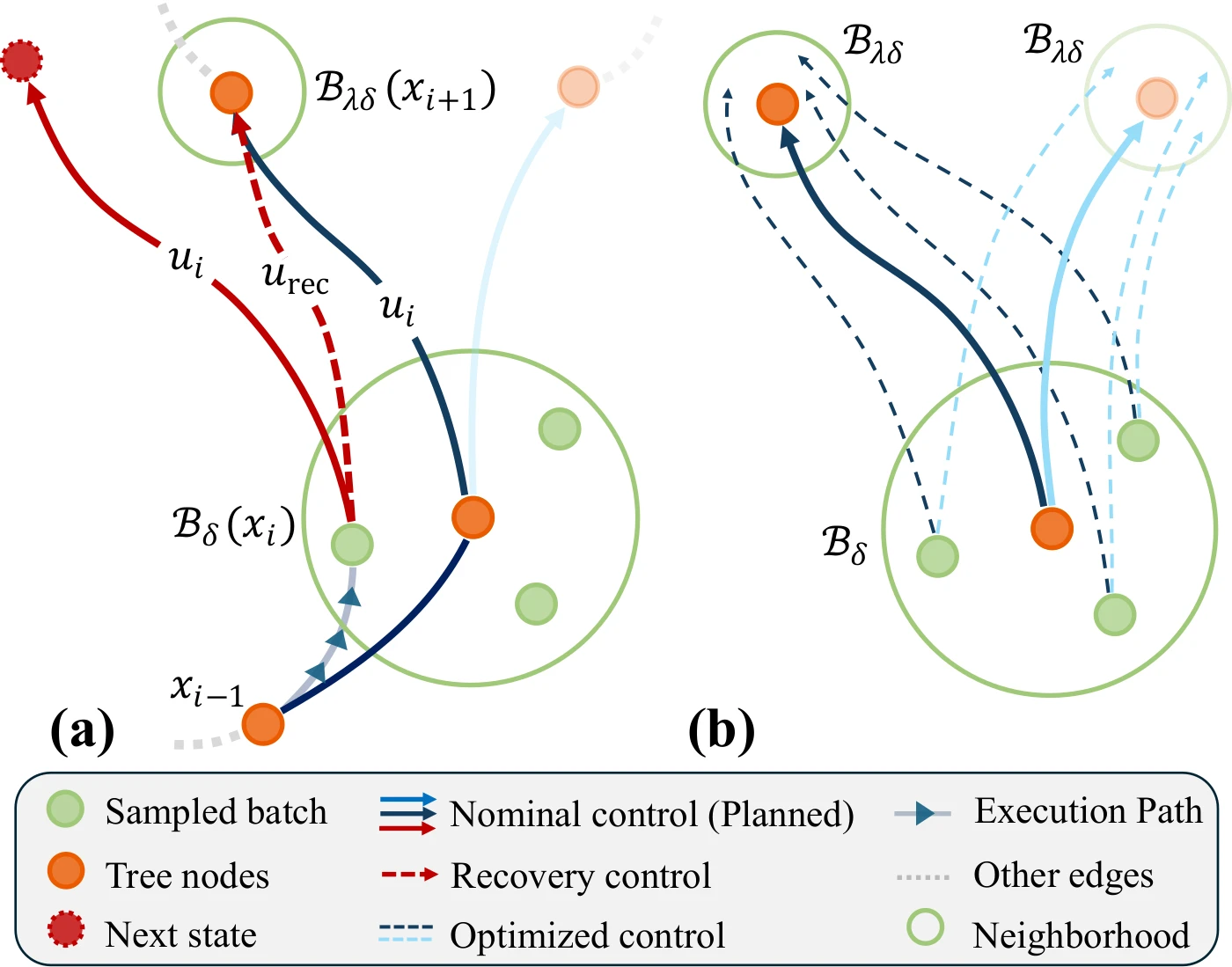
Instead of optimizing from the newly observed state like MPC, AURA samples the states the system might end up in and optimizes recovery controls for all of those outcomes in parallel on the GPU while the current action is still executing. When the actual state is observed, it picks the control computed for the nearest sample. The optimization works with any differentiable dynamics, including learned models.
Backed by theory: For trajectories with enough clearance, a recovery segment from any perturbed state back to the nominal successor is guaranteed to exist, and an approximate recovery is enough to keep the robot inside the planned safety margin.
Better Runtime Quality Trajectory
More Robust Tracking
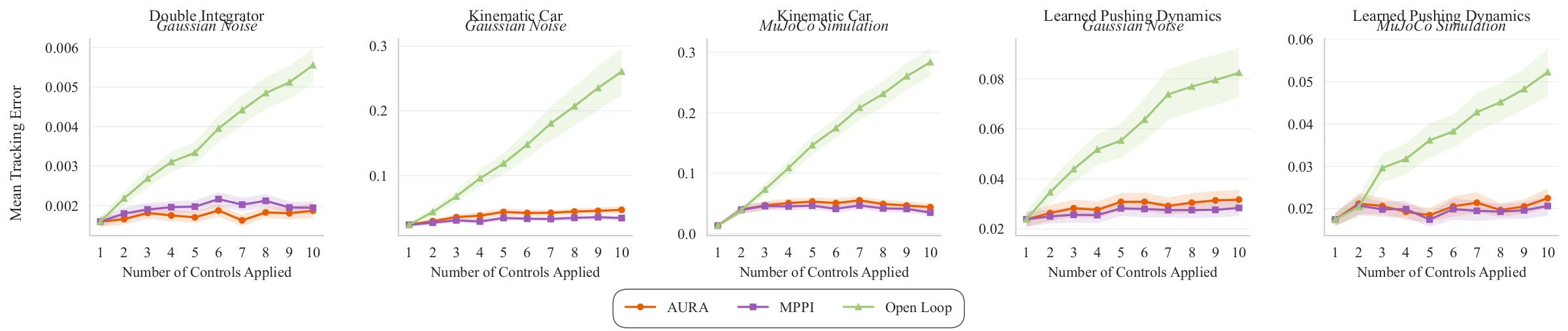
Unlike MPPI, which optimizes only after the new state is observed, AURA has its recovery controls ready before the action finishes, so it can correct course immediately at the synchronization step. Moreover, AURA plans globally all the way to the goal, which makes it well suited for long-horizon tasks.
Faster End-to-End Task Time
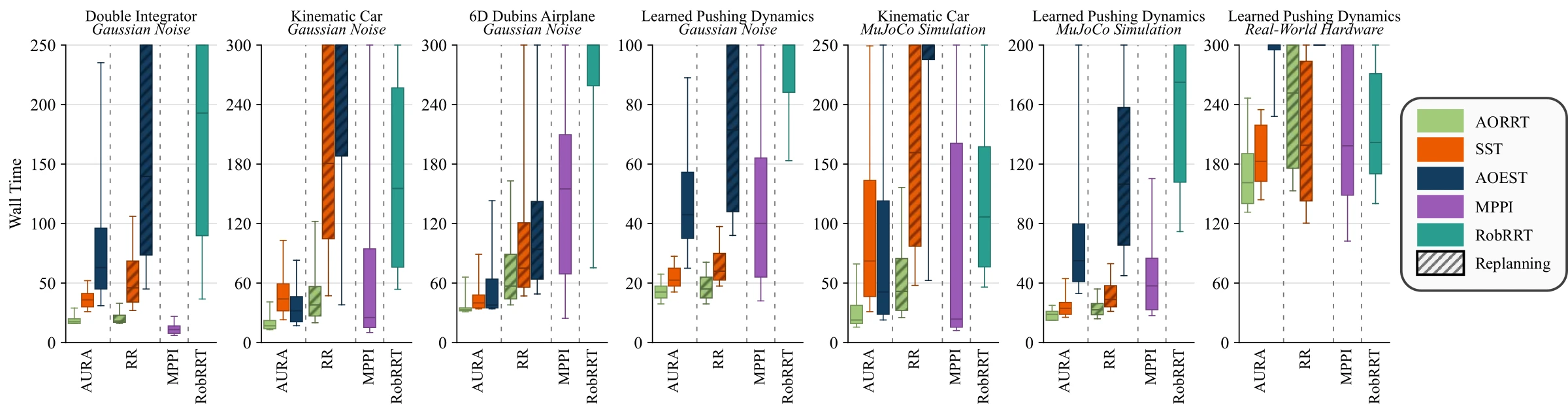
Restart replanning throws away the tree after every large deviation, and MPPI cannot find the optimal path or gets trapped in local minima on long tasks. AURA keeps global exploration and local robustness at the same time.
Lower Offline Planning is Faster!
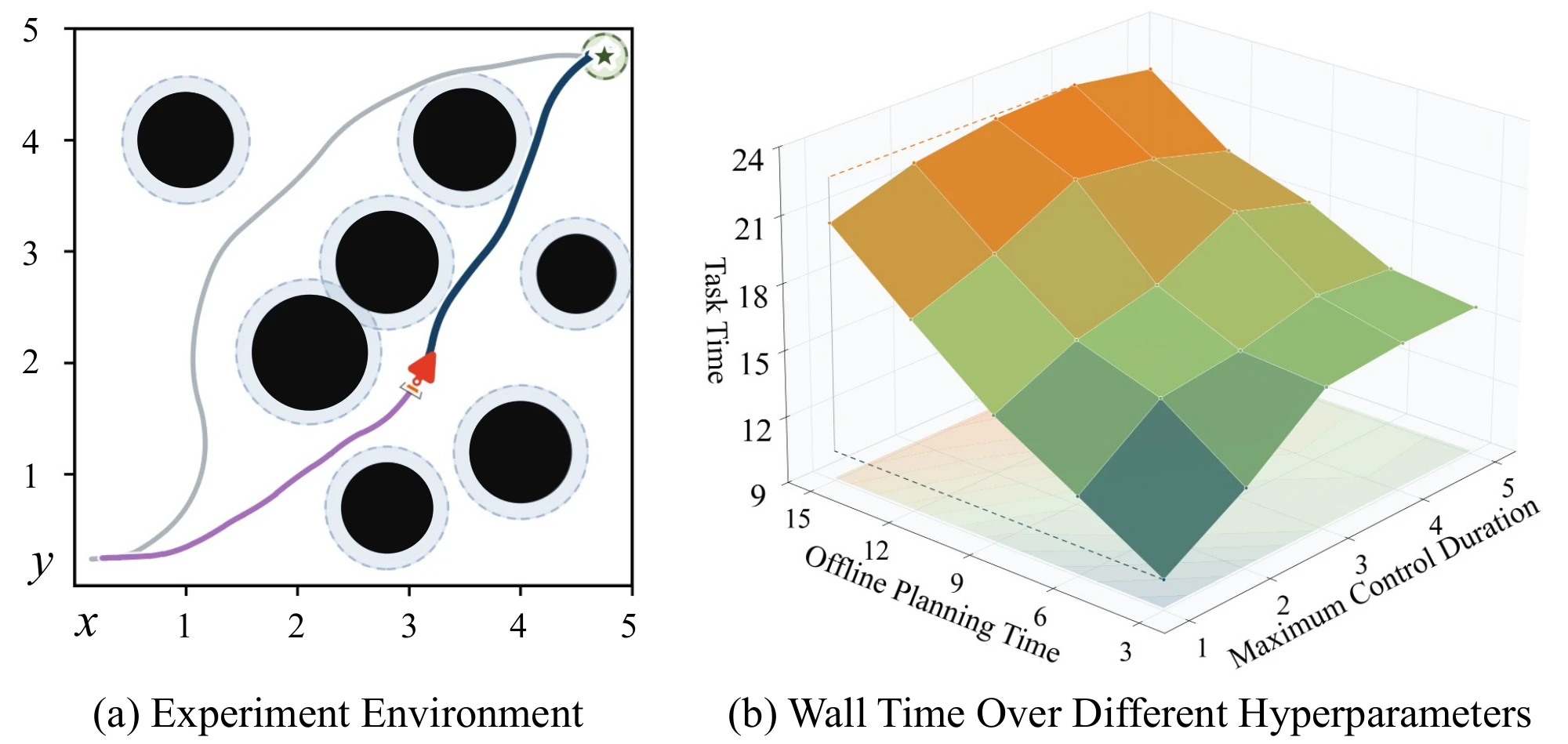
Extra offline planning only pays off if it saves more time than it costs. Because AURA keeps refining during execution, the system is better off once a feasible plan exists and letting replanning find the shortcut on the way.
Simulation: Car and Manipulator in MuJoCo
MuSHR Car
UR10 Non-prehensile Pushing
Uncertainty comes from the mismatch between the simplified dynamics model and the MuJoCo physics, and AURA corrects for it at every step.
Real-world pushing with learned dynamics
Real-world Trial 1
Real-world Trial 2
On a real UR10, state is only observed after each push, so AURA's precomputed recovery controls let the robot correct course at every action boundary despite hardware inaccuracies and unmodeled dynamics.
Acknowledgments
This work was supported in part by the Amazon WPI RBE Research Award 2025, NSF CRII Grant No. 2451108, and Worcester Polytechnic Institute funds.