CoAd
Constant-Time Planning for Continuous Goal Manipulation with Compressed Library and Online Adaptation
Worcester Polytechnic Institute · ELPIS Lab
One workspace, continuously many planning problems
Repeated manipulation in a fixed workcell
Goal-varying motion planning
Packaging, kitting, and pick-and-place applications repeatedly solve nearly the same motion-planning problem. The static workspace is unchanged, but the goal object can occupy infinitely many poses in a continuous task space. Planning from scratch wastes this structure; storing a separate path for every pose is impossible.
CoAd turns this infinite family into a finite, coverage-certified representation, compresses the resulting motion library, and answers each online query with constant-time retrieval followed by lightweight goal adaptation.
Discretize a continuous task space with coverage guarantees
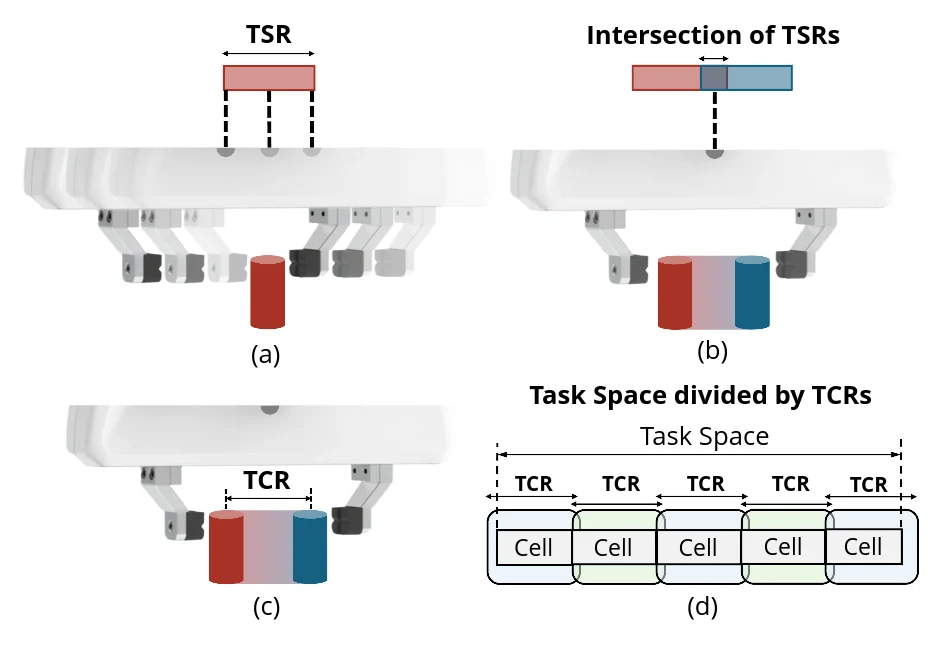
Task Space Region: valid end-effector poses for one object pose
Task Coverage Region: object poses sharing one end-effector goal
A Task Space Region describes all end-effector poses that can complete a task for one object pose. CoAd inverts that relationship: a Task Coverage Region (TCR) describes the continuous set of object poses that can share one fixed end-effector goal. Finite TCR cells cover the bounded task domain and provide direct indexing at query time.
Plan a few roots. Adapt them to cover the rest.
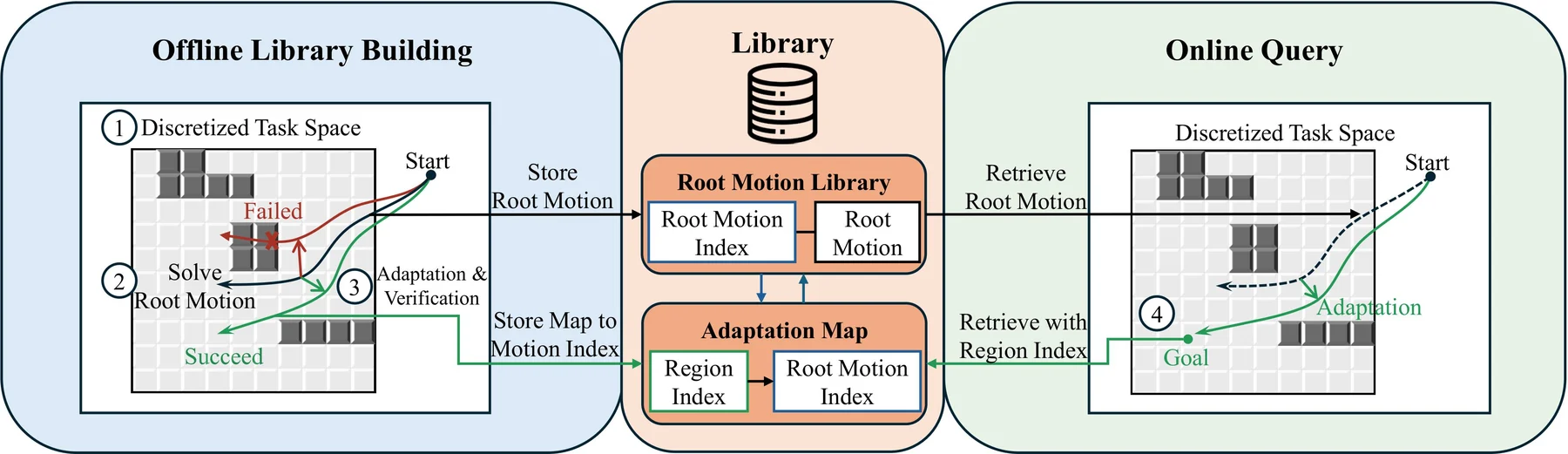
Coverage-preserving compression
CoAd stores root paths only for selected TCRs. A root is adapted to nearby regions and each candidate is checked offline for goal satisfaction and collision avoidance. Successful adaptations replace many individually stored plans without sacrificing coverage.
Constant-time online query
The sensed object pose maps directly to a TCR index. A hash lookup retrieves the associated root motion and goal, after which a fixed-cost adapter produces the final trajectory. Expensive planning and verification remain offline.
Three lightweight adaptation choices
Linear interpolation
Connects the root path endpoint to the queried goal. It is the fastest option, with planning times around 50–90 microseconds in the reported experiments.
Dynamic Movement Primitives
Retargets the full motion while preserving its qualitative shape. DMPs often produce the shortest paths, trading some compression and query speed for path quality.
Simple trajectory optimization
Warm-starts a fixed-size convex refinement from the root motion, balancing velocity, acceleration, and deviation from the stored path.
Experiment setup
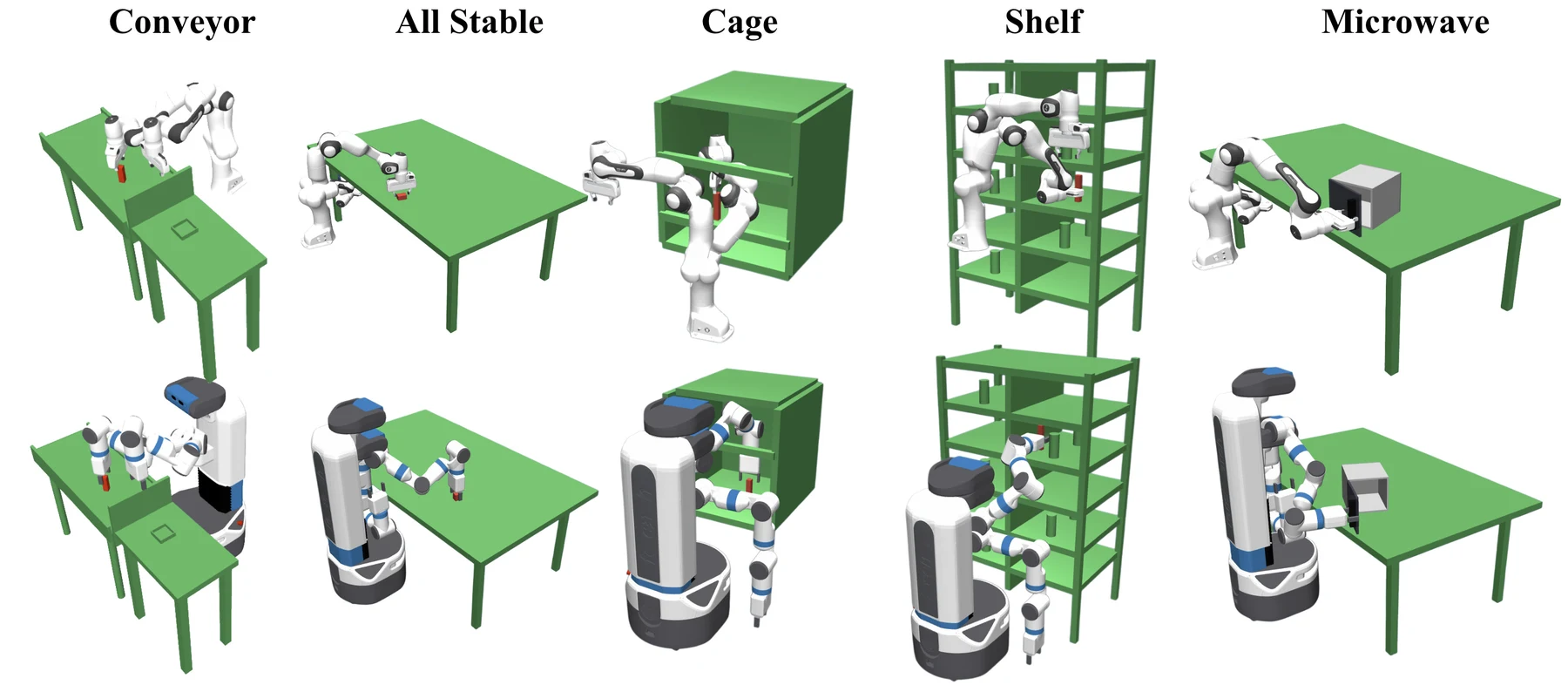
The simulation study spans 7-DOF and 8-DOF manipulators across five environments with continuous position, orientation, stable-placement, height, and articulated-door variations. CoAd is compared with full motion libraries, online RRT-Connect variants, and the experience-based ERT-Connect planner.
Simulation: conveyor task
Planning baselines
RRT-Connect
ERT-Connect
CoAd adaptations
CoAd-LI
CoAd-DMP
CoAd-STO
Real-world validation
Planning baselines
RRT-Connect
Lightning
CoAd adaptations
CoAd-LI
CoAd-DMP
CoAd-STO
The compressed library is built in simulation and transferred directly to a physical UR10. AprilTag perception estimates each new object pose, and CoAd retrieves and adapts a verified motion without replanning from scratch. Across 100 trials, all three CoAd variants achieve 100% success with predictable query time and competitive path quality.
Coverage, compression, and online performance
Compressed plan libraries
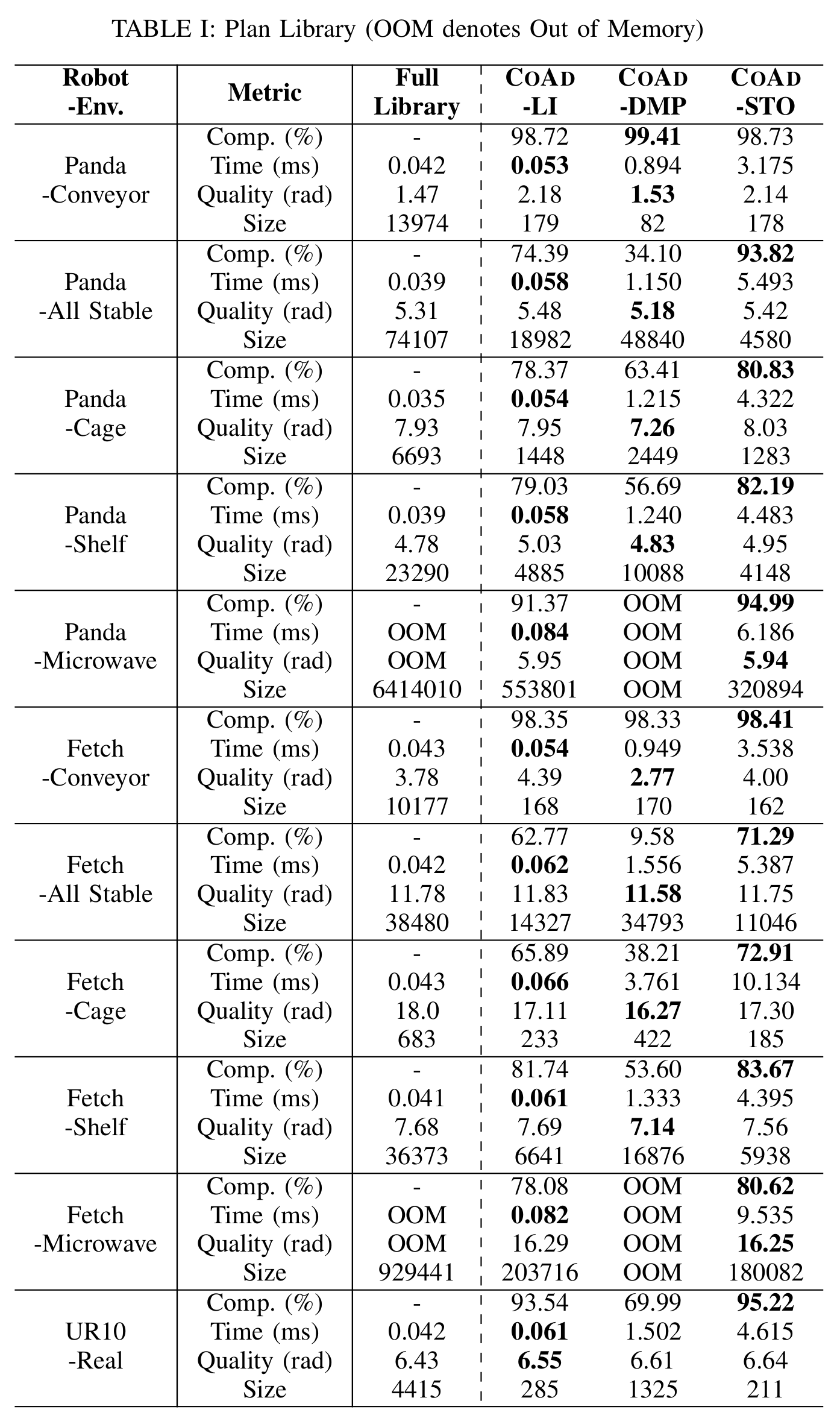
CoAd-LI and CoAd-STO provide the strongest and most consistent compression, reducing the number of stored paths by roughly 63–99% and 71–99%, respectively. CoAd-DMP often produces higher-quality paths but stores more roots in tightly constrained environments.
Success rate and path quality
All available CoAd variants achieve 100% success across the evaluated tasks, while planning-from-scratch and experience-based baselines lose reliability in constrained scenes. CoAd-DMP generally yields the shortest simulated paths, while CoAd-LI gives the best real-world path quality among the compressed variants.
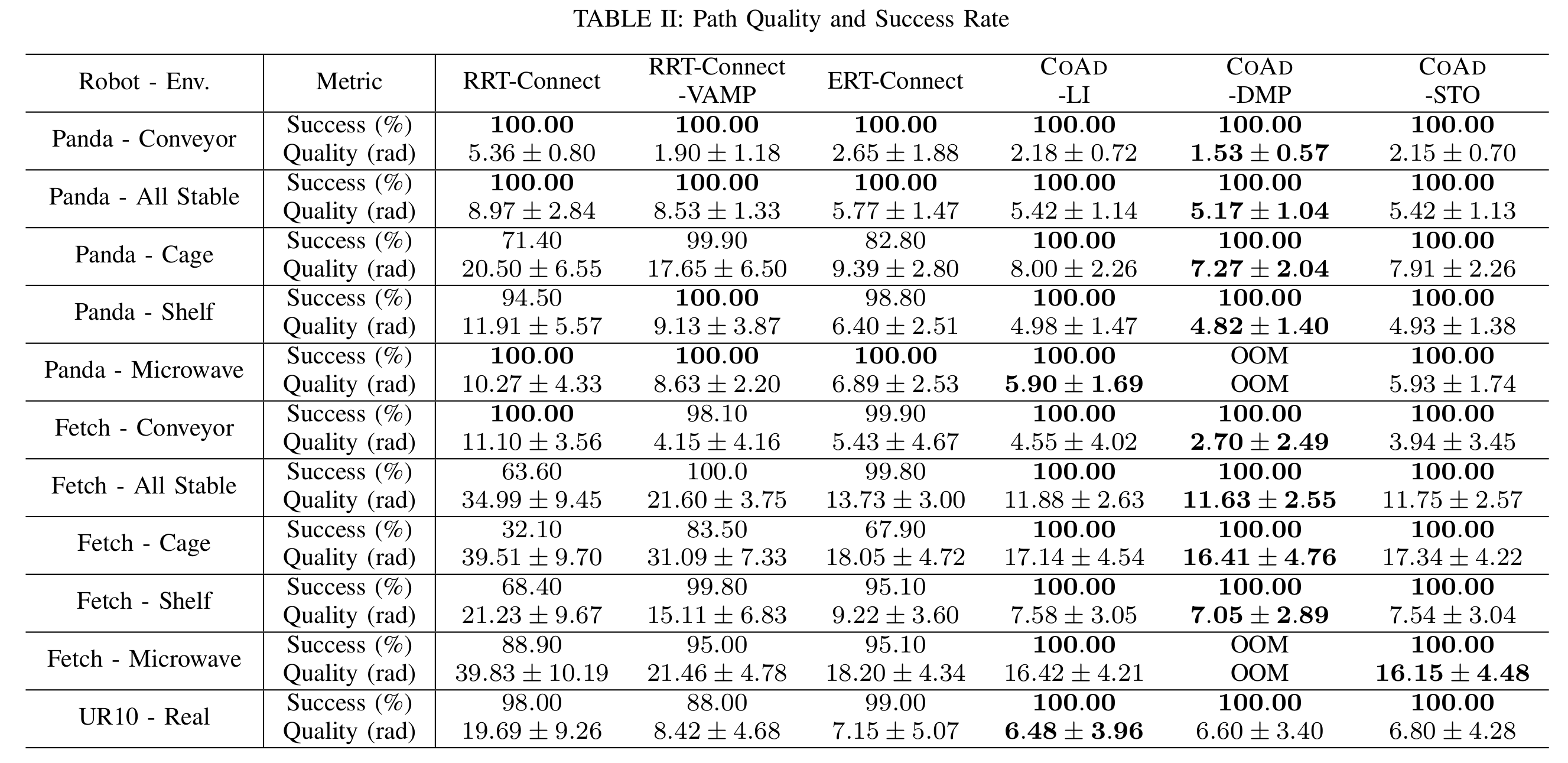
Fast and predictable online queries
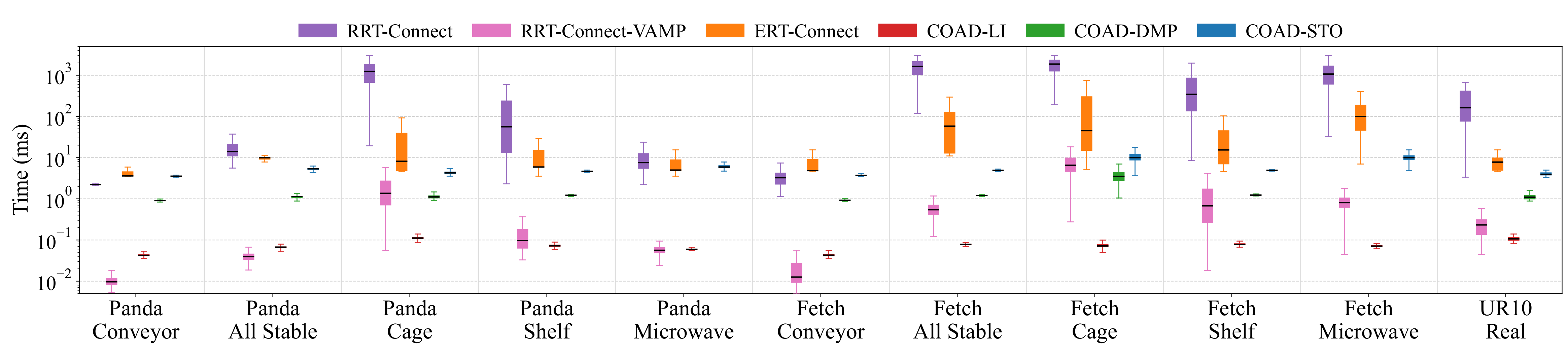
CoAd-LI consistently answers queries in approximately 50–90 microseconds. CoAd-DMP and CoAd-STO remain in the millisecond range, with substantially smaller timing variance than online baselines—empirical support for the framework’s constant-time online complexity.