Planning Under Uncertainty
Generating robust plans in uncertain scenarios.
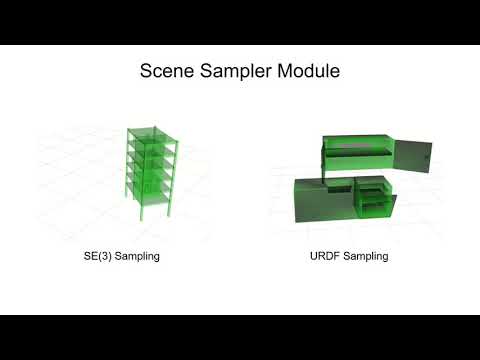
Planning under uncertainty is a significant challenge in robotics, as robots often rely on incomplete geometric information due to sensing limitations. For instance, a robot might only have a partial view of an object, leading to collision with unseen parts. To address this, the ELPIS lab is conducting research in effective motion planning under uncertainty.
Relevant Publications
- IEEE Robotics and Automation Letters, 2026
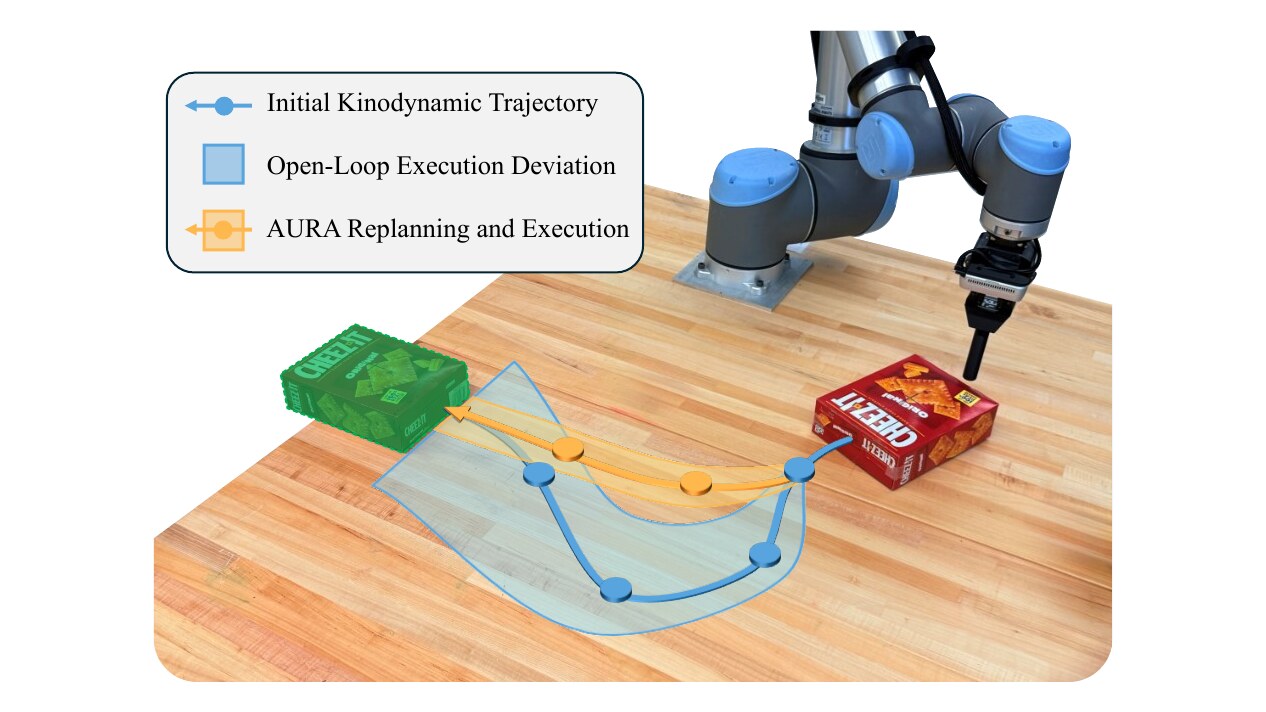
Sampling-based motion planners offer a practical and scalable approach to kinodynamic motion planning, notably for high-dimensional, underactuated, or non-holonomic systems. However, these planners are typically used offline, requiring execution to begin only after the trajectory has been computed. In addition, the planned trajectory may not be accurately tracked in the presence of motion uncertainty, leading to deviations from the nominal solution. In this work, these limitations were addressed within a unified framework, AURA, an asymptotically-optimal meta-planner framework that improves both path quality and tracking performance during execution. In addition to the main execution thread, this framework comprises a replanning method that continuously explores the state space and refines the trajectory during execution, and an optimization process that refines future control inputs to reduce tracking error. Together, these components enable AURA to leverage asymptotically optimal planning online while improving execution accuracy under motion uncertainty. The proposed approach is evaluated in both simulation and real-world environments across multiple systems, demonstrating consistent improvements in trajectory quality, tracking accuracy, and overall performance compared with baselines.
@article{golestaneh2026aura, title = {AURA: Asymptotically Optimal Uncertainty-Robust Replanning Algorithm for Kinodynamic Systems}, author = {Golestaneh, Seyedali and Zhong, Zhuoyun and Lee, Donghyung and Chamzas, Constantinos}, journal = {IEEE Robotics and Automation Letters}, year = {2026}, eprint = {2605.27699}, archiveprefix = {arXiv}, primaryclass = {cs.RO}, url = {https://arxiv.org/abs/2605.27699}, preview = {publication_preview/golestaneh2026aura.jpg} } - arxiv
 2026
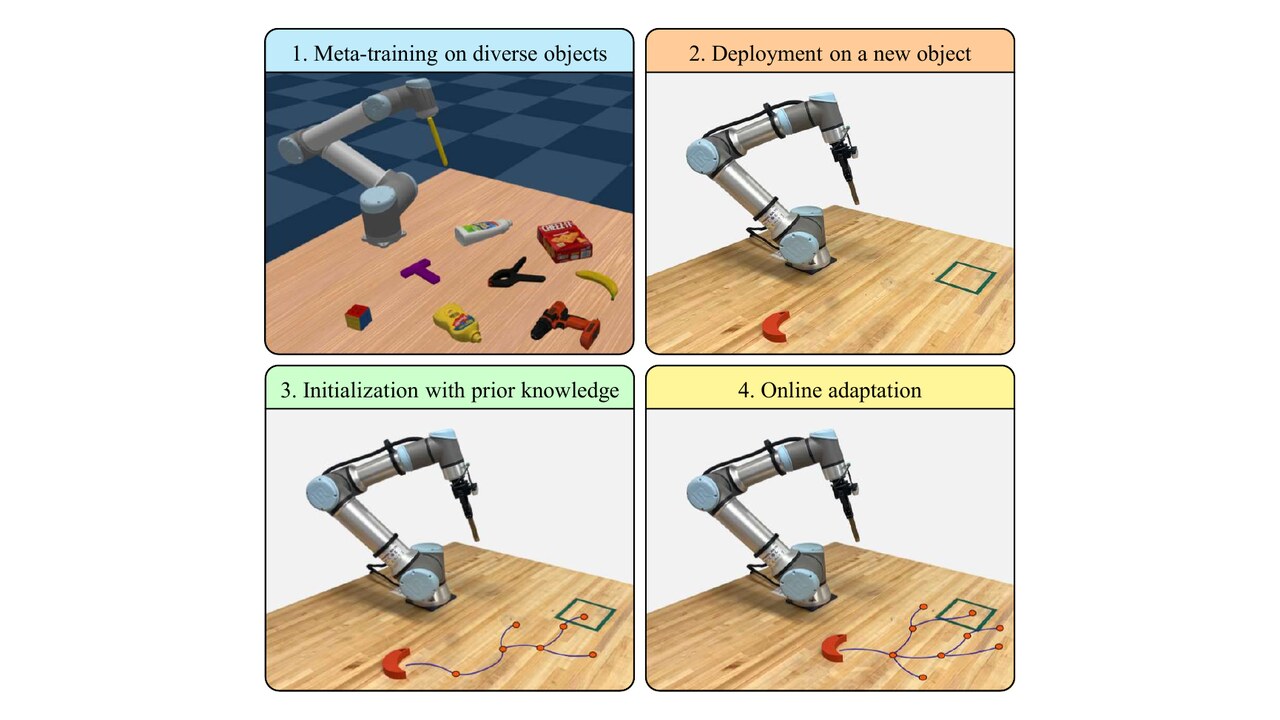
2026Manipulating previously unseen objects remains challenging, as their dynamics depend on latent physical properties, such as friction and mass distribution, that cannot be inferred from perception alone. Prior experience across objects can provide an initial estimate of unseen object dynamics, but this estimate remains uncertain and can degrade further during sim-to-real transfer. Adapting the dynamics through interaction can progressively refine the estimation, however, updating the model may invalidate the planned trajectory. Successful and efficient manipulation therefore requires both rapid dynamics adaptation and a planning strategy that can incorporate this evolution. In this work, we introduce MetaPusher, a meta-learning and adaptive planning framework for nonprehensile manipulation of unseen objects without prior object-specific interactions. A meta-learned dynamics model rapidly adapts from interactions during task execution, while an adaptive kinodynamic planner updates long-horizon plans by reusing and refining its existing search tree. This coupling enables manipulation and adaptation without a separate data collection phase. We evaluate MetaPusher on unseen objects in simulation and in sim-to-real scenarios, comparing against fine-tuning and active learning methods, MPPI-based control, and a reinforcement learning policy. It achieves lower prediction error and improves task success rate by up to 20%.
@misc{golestaneh2026metapusher, title = {MetaPusher: Meta Learning and Planning for Nonprehensile Manipulation of Unseen Objects with Rapid Online Adaption}, author = {Lee*, Donghyung and Golestaneh*, Seyedali and Singh, Jaskrit and Zhong, Zhuoyun and Kapoutsis, Athanasios and Chamzas, Constantinos}, year = {2026}, eprint = {2609.21122}, archiveprefix = {arXiv}, primaryclass = {cs.RO}, url = {https://arxiv.org/abs/2609.21122}, preview = {publication_preview/golestaneh2026metapusher.jpg} } - arxiv
 2026
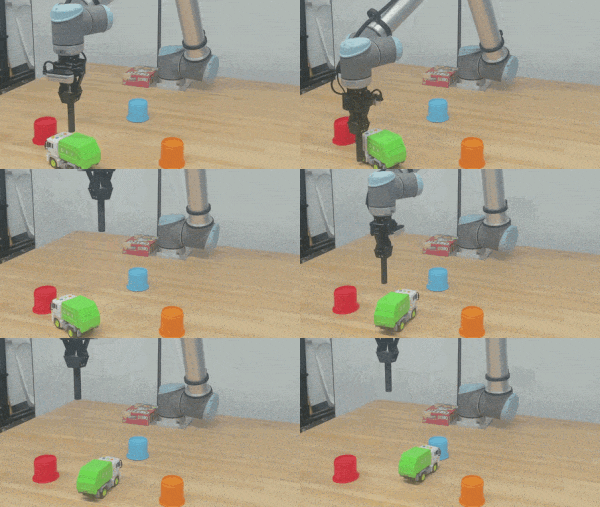
2026In many real-world robotic tasks, robots must generate dynamically feasible motions that reliably reach desired goals even under uncertainty. Yet existing sampling-based kinodynamic planners typically optimize running costs accumulated along trajectories and treat goal reaching as a feasibility check, rather than explicitly optimizing terminal-state quality, such as goal preference or goal-reaching reliability. In this work, we introduce Kinodynamic planning with a Terminal cost, termed KiTe. It augments AO-RRT with a terminal-cost objective to optimize terminal-state quality alongside trajectory running cost. We provide a rigorous proof that this augmented AO-RRT formulation preserves asymptotic optimality. Furthermore, we extend the formulation to belief space and prove that minimizing the Wasserstein distance between the terminal belief and the goal improves a lower bound on the probability of reaching the goal region. To support systems without analytical uncertainty models, we learn dynamics and process uncertainty directly from data and integrate the learned belief dynamics into planning. We validate the proposed formulation with experiments on Flappy Bird, Car Parking, and Planar Pushing with learned belief dynamics in both simulation and the real world. Compared with baselines without terminal costs, KiTe better satisfies goal preferences and consistently achieves higher goal-reaching success under uncertainty.
@misc{zhong2026kite, title = {Terminal Matters: Kinodynamic Planning with a Terminal Cost and Learned Uncertainty in Belief State-Cost Space}, author = {Zhong, Zhuoyun and Golestaneh, Seyedali and Chamzas, Constantinos}, year = {2026}, eprint = {2605.09046}, archiveprefix = {arXiv}, primaryclass = {cs.RO}, url = {https://arxiv.org/abs/2605.09046}, preview = {publication_preview/zhong2026kite.gif} } - In IEEE International Conference on Robotics and Automation, 2026
Best Student Paper Award
Top-3 Finalist for Best Paper in Planning and Control Award
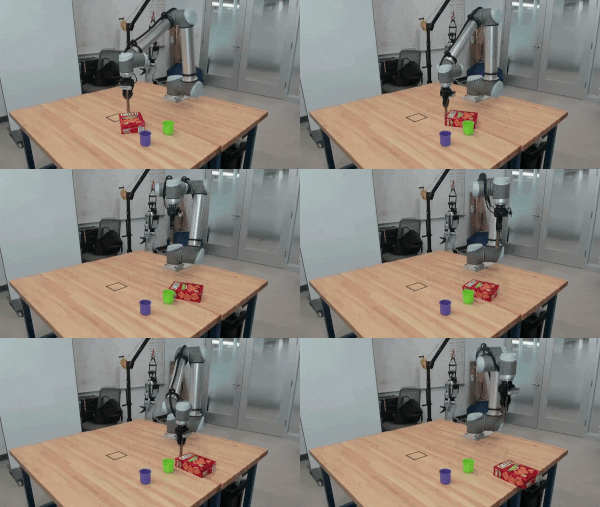
Planning with learned dynamics models offers a promising approach toward versatile real-world manipulation, particularly in nonprehensile settings such as pushing or rolling, where accurate analytical models are difficult to obtain. However, collecting training data for learning-based methods can be costly and inefficient, as it often relies on randomly sampled interactions that are not necessarily the most informative. Furthermore, learned models tend to exhibit high uncertainty in underexplored regions of the skill space, undermining the reliability of long-horizon planning. To address these challenges, we propose ActivePusher, a novel framework that combines residual-physics modeling with uncertainty-based active learning, to focus data acquisition on the most informative skill parameters. Additionally, ActivePusher seamlessly integrates with model-based kinodynamic planners, leveraging uncertainty estimates to bias control sampling toward more reliable actions. We evaluate our approach in both simulation and real-world environments, and demonstrate that it consistently improves data efficiency and achieves higher planning success rates in comparison to baseline methods.
@inproceedings{zhong2026activepusheractivelearningplanning, title = {ActivePusher: Active Learning and Planning with Residual Physics for Nonprehensile Manipulation}, author = {Zhong, Zhuoyun and Golestaneh, Seyedali and Chamzas, Constantinos}, year = {2026}, eprint = {2506.04646}, archiveprefix = {arXiv}, primaryclass = {cs.RO}, url = {https://arxiv.org/abs/2506.04646}, booktitle = {IEEE International Conference on Robotics and Automation}, month = may, preview = {publication_preview/zhong2026activepusher.gif} } - C. Chamzas, C. Garrett, B. Sundaralingam, L. Kavraki, and D. FoxIn RSS 2023: Workshop on Learning for Task and Motion Planning, 2023
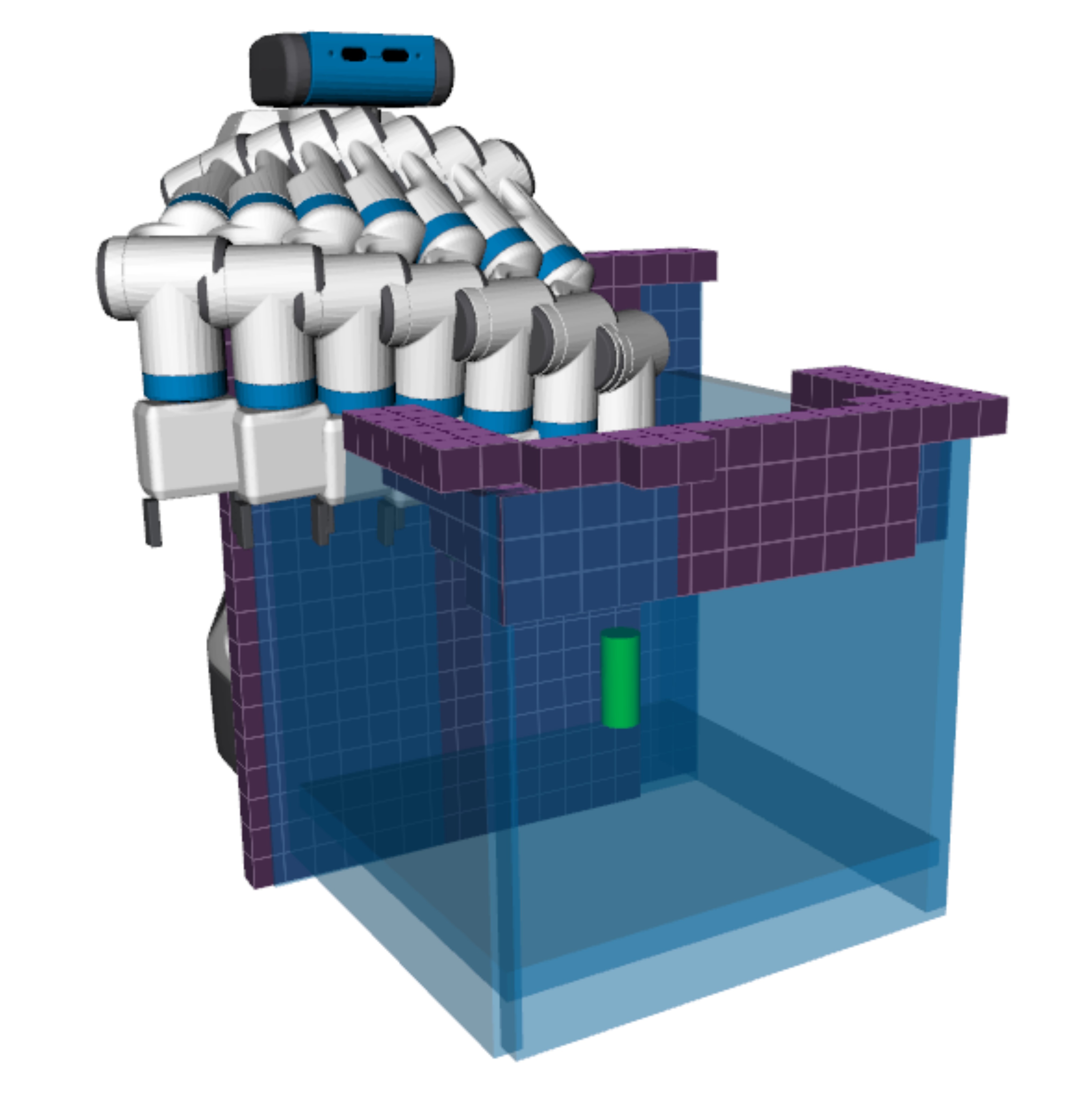
Model-based robotic planning techniques, such as inverse kinematics and motion planning, can endow robots with the ability to perform complex manipulation tasks, such as grasping, object manipulation, and precise placement. However, these methods often assume perfect world knowledge and leverage approximate world models. For example, tasks that involve dynamics such as pushing or pouring are difficult to address with model-based techniques as it is difficult to obtain accurate characterizations of these object dynamics. Additionally, uncertainty in perception prevents them populating an accurate world state estimate. In this work, we propose using a model-based motion planner to build an ensemble of plans under different environment hypotheses. Then, we train a meta-policy to decide online which plan to track based on the current history of observations. By leveraging history, this policy is able to switch ensemble plans to circumvent getting "stuck" in order to complete the task. We tested our method on a 7-DOF Franka-Emika robot pushing a cabinet door in simulation. We demonstrate that a successful meta-policy can be trained to push a door in settings high environment uncertainty all while requiring little data.
@misc{chamzas2023-metapolicy, author = {Chamzas, Constantinos and Garrett, Caelan and Sundaralingam, Balakumar and Kavraki, Lydia E. and Fox, Dieter}, booktitle = {RSS 2023: Workshop on Learning for Task and Motion Planning}, month = jul, title = {Meta-Policy Learning over Plan Ensembles for Robust Articulated Object Manipulation}, year = {2023}, url = {https://openreview.net/forum?id=68N8Dj6KVv} } - C. Quintero-Peña*, C. Chamzas*, Z. Sun, V. Unhelkar, and L. E. KavrakiIn IEEE International Conference on Robotics and Automation, 2022
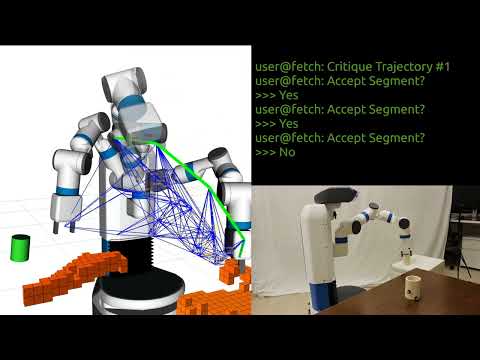
Motion planning is a core problem in robotics, with a range of existing methods aimed to address its diverse set of challenges. However, most existing methods rely on complete knowledge of the robot environment; an assumption that seldom holds true due to inherent limitations of robot perception. To enable tractable motion planning for high-DOF robots under partial observability, we introduce BLIND, an algorithm that leverages human guidance. BLIND utilizes inverse reinforcement learning to derive motion-level guidance from human critiques. The algorithm overcomes the computational challenge of reward learning for high-DOF robots by projecting the robot’s continuous configuration space to a motion-planner-guided discrete task model. The learned reward is in turn used as guidance to generate robot motion using a novel motion planner. We demonstrate BLIND using the Fetch robot an dperform two simulation experiments with partial observability. Our experiments demonstrate that, despite the challenge of partial observability and high dimensionality, BLIND is capable of generating safe robot motion and outperforms baselines on metrics of teaching efficiency, success rate, and path quality.
@inproceedings{quintero-chamzas2022-blind, author = {Quintero-Pe{\~n}a*, Carlos and Chamzas*, Constantinos and Sun, Zhanyi and Unhelkar, Vaibhav and E. Kavraki, Lydia}, booktitle = {IEEE International Conference on Robotics and Automation}, month = may, pages = {7226-7232}, doi = {10.1109/ICRA46639.2022.9811893}, title = {Human-Guided Motion Planning in Partially Observable Environments}, url = {https://doi.org/10.1109/ICRA46639.2022.9811893}, year = {2022} } - C. Chamzas, C. Quintero-Peña, Z. Kingston, A. Orthey, D. Rakita, M. Gleicher, M. Toussaint, and L. E. KavrakiIEEE Robotics and Automation Letters, 2022
Recently, there has been a wealth of development in motion planning for robotic manipulationnew motion planners are continuously proposed, each with its own unique set of strengths and weaknesses. However, evaluating these new planners is challenging, and researchers often create their own ad-hoc problems for benchmarking, which is time-consuming, prone to bias, and does not directly compare against other state-of-the-art planners. We present MotionBenchMaker, an open-source tool to generate benchmarking datasets for realistic robot manipulation problems. MotionBenchMaker is designed to be an extensible, easy-to-use tool that allows users to both generate datasets and benchmark them by comparing motion planning algorithms. Empirically, we show the benefit of using MotionBenchMaker as a tool to procedurally generate datasets which helps in the fair evaluation of planners. We also present a suite of over 40 prefabricated datasets, with 5 different commonly used robots in 8 environments, to serve as a common ground for future motion planning research.
@article{chamzas2022-motion-bench-maker, title = {MotionBenchMaker: A Tool to Generate and Benchmark Motion Planning Datasets}, volume = {7}, number = {2}, pages = {882–889}, issn = {2377-3766}, doi = {10.1109/LRA.2021.3133603}, journal = {IEEE Robotics and Automation Letters}, author = {Chamzas, Constantinos and Quintero-Pe{\~n}a, Carlos and Kingston, Zachary and Orthey, Andreas and Rakita, Daniel and Gleicher, Michael and Toussaint, Marc and E. Kavraki, Lydia}, year = {2022}, month = apr, url = {https://dx.doi.org/10.1109/LRA.2021.3133603} } - C. Quintero-Peña*, C. Chamzas*, V. Unhelkar, and L. E. KavrakiIn ICRA 2021: Workshop on Machine Learning for Motion Planning, 2021
Spotlight
Motion planning is a core problem in many applications spanning from robotic manipulation to autonomous driving. Given its importance, several schools of methods have been proposed to address the motion planning problem. However, most existing solutions require complete knowledge of the robot’s environment; an assumption that might not be valid in many real-world applications due to occlusions and inherent limitations of robots’ sensors. Indeed, relatively little emphasis has been placed on developing safe motion planning algorithms that work in partially unknown environments. In this work, we investigate how a human who can observe the robot’s workspace can enable motion planning for a robot with incomplete knowledge of its workspace. We propose a framework that combines machine learning and motion planning to address the challenges of planning motions for high-dimensional robots that learn from human interaction. Our preliminary results indicate that the proposed framework can successfully guide a robot in a partially unknown environment quickly discovering feasible paths.
@misc{quintero-chamzas2021-motion-planning-in-the-dark,
  author = {Quintero-Pe{\~n}a*, Carlos and Chamzas*, Constantinos and Unhelkar, Vaibhav and E. Kavraki, Lydia},
  booktitle = {ICRA 2021: Workshop on Machine Learning for Motion Planning},
  month = jun,
  title = {Motion Planning via Bayesian Learning in the Dark},
  year = {2021},
  url = {https://sites.google.com/utexas.edu/mlmp-icra2021/home}
}